merge: decide what to bring back together
After branching, choose what to combine. Features, predictions and separated observations have different meanings. The argument determines the operation.
Choose the result you need
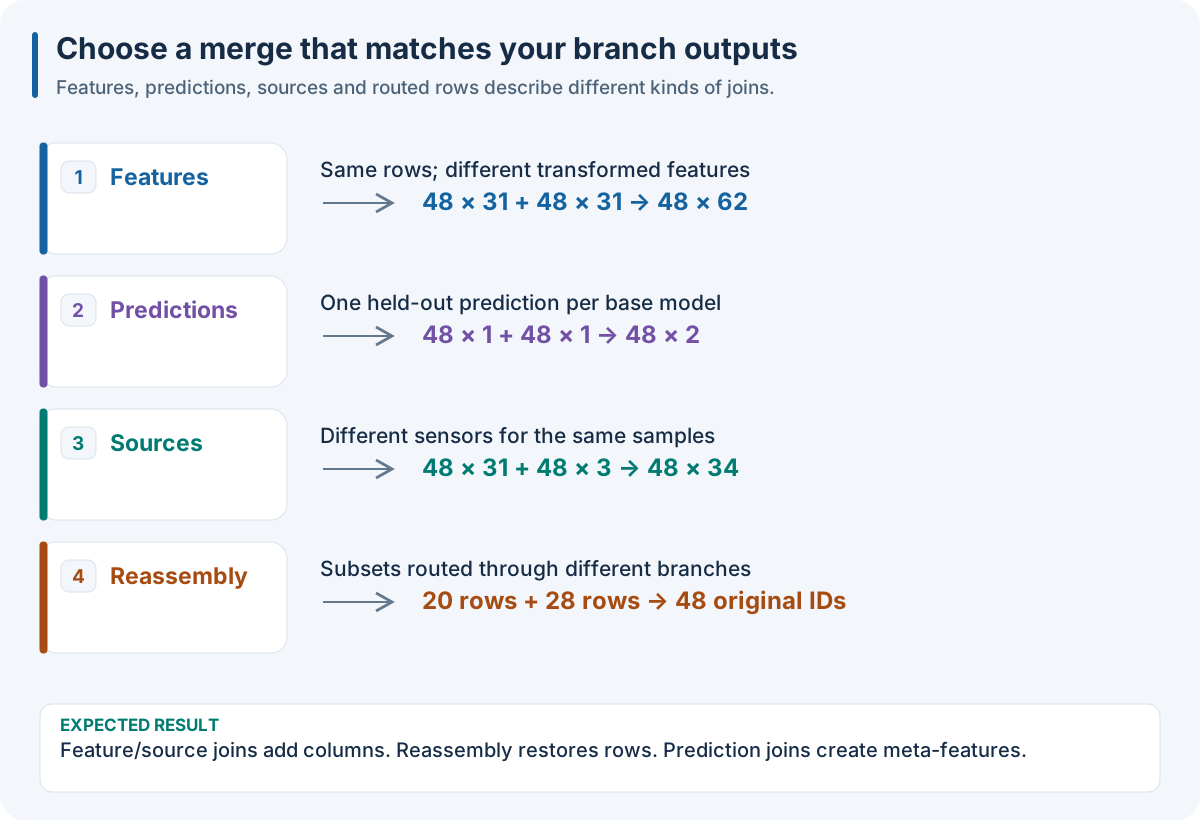
Read the output axis: a merge can widen a matrix, build stacking inputs or restore observation rows.
You have |
You want |
Write |
Example output |
|---|---|---|---|
Two feature branches, each 48 × 31 |
One learner using both |
|
48 × 62 |
Two single-target base regressors |
A combiner of their predictions |
|
48 × 2 |
Two 31-feature branches, each with a regressor |
Both features and predictions |
|
48 × 64 |
Different observation cohorts |
Original observation order |
|
48 rows, original width |
31 spectral + three marker features |
Matrix for a classical learner |
|
48 × 34 |
Equal-width sources |
A source axis |
|
Source-axis representation |
Sources for a source-aware model |
Named blocks retained |
|
Named source blocks |
Rows match by observation identity. Do not independently sort sources and then assume that matching row positions represent the same specimens.
Worked example: combine predictions safely
SNV + PLS and standardization + Ridge may make complementary errors. A final Ridge learns to combine their predictions. This is stacking: its features are model outputs, not wavelengths.
Note
These tabs express the same Python SDK workflow. JSON and YAML are recipe files; Python can also use sklearn/nirs4all objects. R, Octave and WASM native pipeline facades do not execute this host-controller node directly. For a recipe that runs in those languages, use 10. Run the same recipe in your language.
{
  "pipeline": [
    {
      "split": {
        "class": "sklearn.model_selection.KFold",
        "params": {
          "n_splits": 3,
          "shuffle": true,
          "random_state": 17
        }
      }
    },
    {
      "branch": {
        "pls": [
          {
            "class": "nirs4all.operators.transforms.StandardNormalVariate"
          },
          {
            "model": {
              "class": "sklearn.cross_decomposition.PLSRegression",
              "params": {
                "n_components": 3
              }
            }
          }
        ],
        "ridge": [
          {
            "class": "sklearn.preprocessing.StandardScaler"
          },
          {
            "model": {
              "class": "sklearn.linear_model.Ridge",
              "params": {
                "alpha": 1.0
              }
            }
          }
        ]
      }
    },
    {
      "merge": "predictions"
    },
    {
      "model": {
        "class": "sklearn.linear_model.Ridge",
        "params": {
          "alpha": 0.1
        }
      }
    }
  ]
}
pipeline:
- split:
    class: sklearn.model_selection.KFold
    params:
      n_splits: 3
      shuffle: true
      random_state: 17
- branch:
    pls:
    - class: nirs4all.operators.transforms.StandardNormalVariate
    - model:
        class: sklearn.cross_decomposition.PLSRegression
        params:
          n_components: 3
    ridge:
    - class: sklearn.preprocessing.StandardScaler
    - model:
        class: sklearn.linear_model.Ridge
        params:
          alpha: 1.0
- merge: predictions
- model:
    class: sklearn.linear_model.Ridge
    params:
      alpha: 0.1
import tempfile
import numpy as np
import nirs4all
from nirs4all.data.dataset import SpectroDataset
from sklearn.model_selection import KFold
from sklearn.preprocessing import StandardScaler
from sklearn.cross_decomposition import PLSRegression
from sklearn.linear_model import Ridge
from nirs4all.operators.transforms import SNV

rng = np.random.default_rng(17)
X = rng.normal(size=(48, 31))
y = 2 * X[:, 10] - X[:, 20] + rng.normal(scale=0.1, size=48)
dataset = SpectroDataset("worked_node")
dataset.add_samples(X[:40], {"partition": "train"},
                    headers=[str(i) for i in range(31)])
dataset.add_samples(X[40:], {"partition": "test"})
dataset.add_targets(y.reshape(-1, 1))


pipeline = [
    KFold(n_splits=3, shuffle=True, random_state=17),
    {"branch": {
        "pls": [SNV(), {"model": PLSRegression(n_components=3)}],
        "ridge": [StandardScaler(), {"model": Ridge(alpha=1.0)}],
    }},
    {"merge": "predictions"},
    {"model": Ridge(alpha=0.1)},
]
with tempfile.TemporaryDirectory() as workspace:
    result = nirs4all.run(pipeline, dataset, engine="dag-ml",
                         workspace_path=workspace, save_charts=False, verbose=0)
    print("CV validation score:", result.cv_best_score)
    print("Selected model test RMSE:", result.best_rmse)
    result.close()
What to expect: each base model provides one prediction column, giving the combiner two columns for the same observation IDs. For training rows, the values come from models that excluded the corresponding row from fitting: out-of-fold (OOF) predictions. New observations pass through the saved base models before the final Ridge predicts.
OOF prevents teaching the combiner with overly optimistic predictions on rows a base model already learned. Choosing the architecture still consumes validation information. Keep an outer holdout for an independent final claim. The synthetic example explains the mechanism without promising a better score.
Combine features instead
These branches contain transforms only. The learner comes after the merge.
{
  "pipeline": [
    {
      "split": {
        "class": "sklearn.model_selection.KFold",
        "params": {
          "n_splits": 3,
          "shuffle": true,
          "random_state": 17
        }
      }
    },
    {
      "branch": {
        "normalized": [
          {
            "class": "nirs4all.operators.transforms.StandardNormalVariate"
          }
        ],
        "smoothed": [
          {
            "class": "nirs4all.operators.transforms.SavitzkyGolay",
            "params": {
              "window_length": 7,
              "polyorder": 2,
              "deriv": 0
            }
          }
        ]
      }
    },
    {
      "merge": "features"
    },
    {
      "model": {
        "class": "sklearn.linear_model.Ridge",
        "params": {
          "alpha": 1.0
        }
      }
    }
  ]
}
pipeline:
- split:
    class: sklearn.model_selection.KFold
    params:
      n_splits: 3
      shuffle: true
      random_state: 17
- branch:
    normalized:
    - class: nirs4all.operators.transforms.StandardNormalVariate
    smoothed:
    - class: nirs4all.operators.transforms.SavitzkyGolay
      params:
        window_length: 7
        polyorder: 2
        deriv: 0
- merge: features
- model:
    class: sklearn.linear_model.Ridge
    params:
      alpha: 1.0
from nirs4all.operators.transforms import SavitzkyGolay
from nirs4all.operators.transforms import StandardNormalVariate as SNV
from sklearn.linear_model import Ridge
from sklearn.model_selection import KFold

pipeline = [{'split': KFold(n_splits=3, shuffle=True, random_state=17)},
 {'branch': {'normalized': [SNV()],
             'smoothed': [SavitzkyGolay(window_length=7, polyorder=2, deriv=0)]}},
 {'merge': 'features'},
 {'model': Ridge(alpha=1.0)}]
Expected result: 62 columns: all normalized columns followed by all smoothed columns. One Ridge learns from that matrix. Compare against each single view before concluding that extra columns help.
Select particular blocks
This fragment selects branches 0 and 1 and keeps pre-branch features. For two 31-column branches and 31 originals, the result has 93 columns.
{
  "merge": {
    "features": {
      "branches": [
        0,
        1
      ]
    },
    "include_original": true,
    "output_as": "features",
    "on_missing": "error",
    "on_shape_mismatch": "error"
  }
}
merge:
  features:
    branches:
    - 0
    - 1
  include_original: true
  output_as: features
  on_missing: error
  on_shape_mismatch: error
merge_step = {'merge': {'features': {'branches': [0, 1]},
           'include_original': True,
           'output_as': 'features',
           'on_missing': 'error',
           'on_shape_mismatch': 'error'}}
You can specify features and predictions in the same mapping. Retaining
original inputs changes model width, scaling balance and required capacity.
Select and name the source fusion
For a two-source dataset whose declared names are source_0 (31 spectral
features) and source_1 (three laboratory markers), this fragment chooses those
two blocks explicitly. It operates on sources rather than duplication branches.
{
  "merge": {
    "sources": {
      "strategy": "concat",
      "sources": [
        "source_0",
        "source_1"
      ],
      "on_incompatible": "error",
      "output_name": "spectra_and_markers",
      "preserve_source_info": true
    }
  }
}
merge:
  sources:
    strategy: concat
    sources:
    - source_0
    - source_1
    on_incompatible: error
    output_name: spectra_and_markers
    preserve_source_info: true
merge_step = {'merge': {'sources': {'strategy': 'concat',
                       'sources': ['source_0', 'source_1'],
                       'on_incompatible': 'error',
                       'output_name': 'spectra_and_markers',
                       'preserve_source_info': True}}}
Expected result: 34 columns for each shared observation, named
spectra_and_markers. Source names identify provenance; they are not inferred
from the scientific meaning of column values.
Source-merge field |
Choices / purpose |
|---|---|
|
|
|
|
|
|
|
Label of merged source |
|
Retain input-source provenance metadata |
flatten falls back to column concatenation; pad introduces zero-filled
positions; truncate discards features to match the shorter width. Prefer
error until you have chosen and documented the scientific meaning of a fallback.
Enumerate merge options
Key |
Controls |
Starting choice |
|---|---|---|
|
All branch features, indices, or |
|
|
Base predictions, indices, per-branch selection |
|
|
|
|
|
Reassemble separated rows when true |
|
|
Retain inputs from before branching |
False unless needed |
|
|
|
|
Incompatible output shapes |
|
|
Output representation |
|
|
Disable OOF reconstruction |
Leave false |
|
Labels for retained source outputs |
Meaningful modality names |
merge_sources and merge_predictions are aliases handled by the same controller.
Advanced per-branch prediction selection includes best, top_k, metrics and
aggregation. See Pipeline Keywords Reference for exact mappings.
Common mistakes
concatrestores separated rows;featuresjoins branch columns.stackneeds compatible source widths and a consumer that accepts that axis.unsafe: truedoes not repair missing OOF predictions. Fix the fold plan or missing base model outputs before trusting evaluation.Silently skipping missing branches changes the meaning of model columns.
Executable fusion and stacking companion: D08. Start with branch: let the same samples follow different paths if merge inputs remain unclear.