Generator keywords: choices, combinations and their exact outputs
Start with Generators: turn an experiment plan into concrete recipes for the six-recipe walkthrough. This page answers the next question: what exactly does each keyword produce? Each small example has the same input in JSON, YAML and Python. The Python tab calls the real generator and prints the expanded values without fitting a model. The letter examples are expansion exercises, not importable operators.
Note
These tabs express the same Python SDK workflow. JSON and YAML are recipe files; Python can also use sklearn/nirs4all objects. R, Octave and WASM native pipeline facades do not execute this host-controller node directly. For a recipe that runs in those languages, use 10. Run the same recipe in your language.
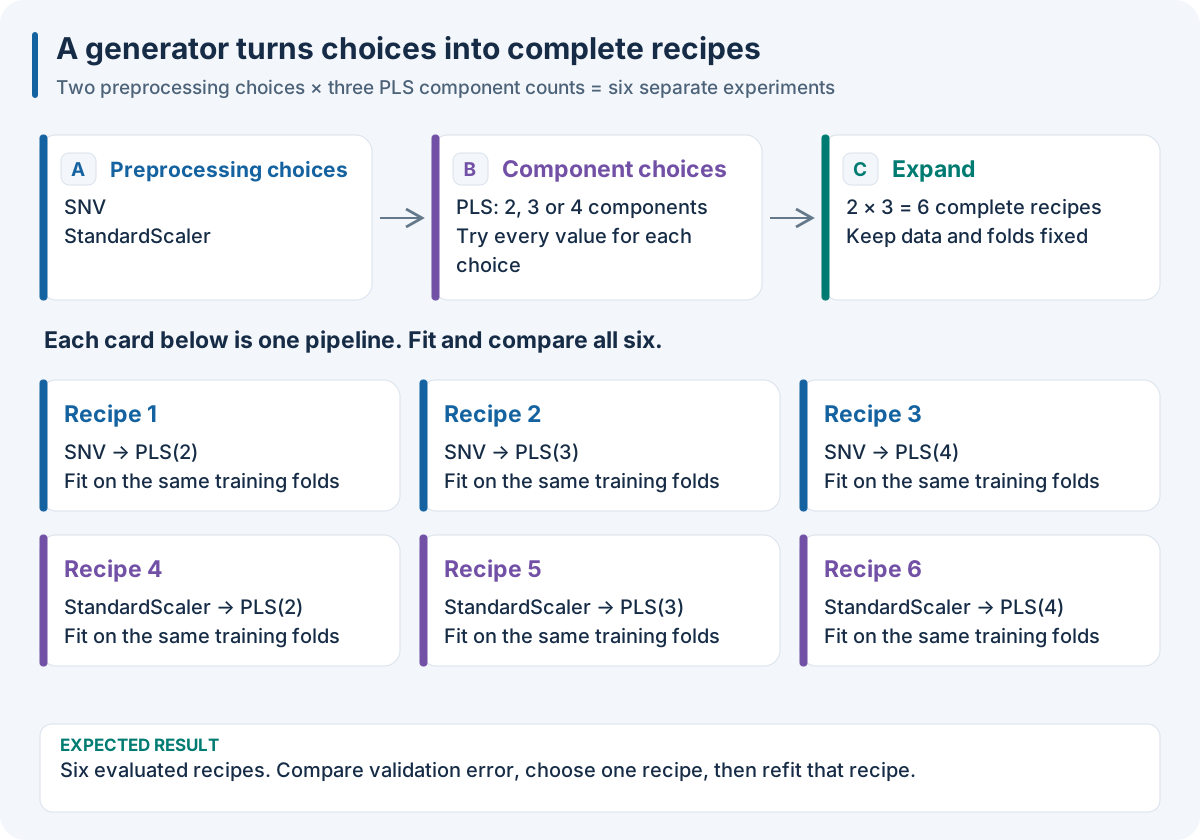
Independent choice counts multiply. Inspect expansion before committing to model fitting.
Clickable keyword index
Task |
Keywords |
|---|---|
Generate choices |
|
Combine parameters or stages |
|
Select sets or sequences |
|
Limit/reproduce selection |
|
Constrain choices |
|
Reuse choices |
|
Advanced/reserved names |
Alternatives and numeric values
_or_
Choose one alternative. Use this for one preprocessing operator, model family or categorical setting per recipe.
{
  "_or_": [
    "SNV",
    "MSC",
    "raw"
  ]
}
_or_:
- SNV
- MSC
- raw
from nirs4all.pipeline.config.generator import expand_spec

spec = {'_or_': ['SNV', 'MSC', 'raw']}
print(expand_spec(spec))
Expanded result: SNV, MSC, raw: three independent choices.
At pipeline level, put actual importable operator descriptions in place of these labels. To apply several choices together, add pick or arrange below.
_range_
Generate a numeric sequence with an inclusive upper bound. In [start, end, step], the third value is the increment, not the number of points.
{
  "_range_": [
    2,
    8,
    2
  ]
}
_range_:
- 2
- 8
- 2
from nirs4all.pipeline.config.generator import expand_spec

spec = {'_range_': [2, 8, 2]}
print(expand_spec(spec))
Expanded result: [2, 4, 6, 8]: four PLS component counts.
The two-value form [2, 4] defaults to step 1 and produces 2, 3, 4. A mapping can use from, to, step. Floating steps and descending ranges are supported. Step must be nonzero and point in the intended direction. Avoid assigning more PLS components than the training rank permits.
_log_range_
Generate a specified number of points spaced multiplicatively. Use this when strengths span orders of magnitude.
{
  "_log_range_": [
    0.001,
    1.0,
    4
  ]
}
_log_range_:
- 0.001
- 1.0
- 4
from nirs4all.pipeline.config.generator import expand_spec

spec = {'_log_range_': [0.001, 1.0, 4]}
print(expand_spec(spec))
Expanded result: approximately [0.001, 0.01, 0.1, 1.0].
The third value is num, unlike _range_ where it is a step. Endpoints must be positive. A mapping can use from, to, num; prefer explicit num to avoid ambiguity.
_sample_
Draw parameter values from a probability distribution. This is random-search planning, not sampling training observations.
{
  "_sample_": {
    "distribution": "uniform",
    "from": 0,
    "to": 1,
    "num": 3
  },
  "_seed_": 42
}
_sample_:
  distribution: uniform
  from: 0
  to: 1
  num: 3
_seed_: 42
from nirs4all.pipeline.config.generator import expand_spec

spec = {'_sample_': {'distribution': 'uniform', 'from': 0, 'to': 1, 'num': 3}, '_seed_': 42}
print(expand_spec(spec))
Expanded result: approximately [0.6394268, 0.0250108, 0.2750293].
_seed_ makes the draw repeatable. Without a seed, repeated expansion may produce different candidate values.
Distribution |
Required settings |
Useful for |
|---|---|---|
|
|
Bounded continuous parameters |
|
Positive |
Regularization/learning rates across orders of magnitude |
|
|
Values centered around a plausible mean |
|
|
Categories; draws can repeat |
Products, paired parameters and ordered alternatives
_grid_
Try every parameter combination. Each result is a mapping of constructor parameters.
{
  "_grid_": {
    "alpha": [
      0.1,
      1.0
    ],
    "fit_intercept": [
      true,
      false
    ]
  }
}
_grid_:
  alpha:
  - 0.1
  - 1.0
  fit_intercept:
  - true
  - false
from nirs4all.pipeline.config.generator import expand_spec

spec = {'_grid_': {'alpha': [0.1, 1.0], 'fit_intercept': [True, False]}}
print(expand_spec(spec))
Expanded result: four mappings: (0.1, true), (0.1, false), (1.0, true), (1.0, false).
Place this under a serialized estimator’s params. The two lists each have length 2, so the product has 4 results. Nested generators such as _range_ can supply parameter values.
_zip_
Pair values by their positions instead of trying every combination. This is useful for approved smoothing-window/polynomial settings.
{
  "_zip_": {
    "window_length": [
      7,
      11,
      15
    ],
    "polyorder": [
      2,
      3,
      3
    ]
  }
}
_zip_:
  window_length:
  - 7
  - 11
  - 15
  polyorder:
  - 2
  - 3
  - 3
from nirs4all.pipeline.config.generator import expand_spec

spec = {'_zip_': {'window_length': [7, 11, 15], 'polyorder': [2, 3, 3]}}
print(expand_spec(spec))
Expanded result: three mappings: (7, 2), (11, 3), (15, 3).
_grid_ would create nine combinations. _zip_ creates three. Unequal lists stop at the shortest list; the current implementation does not raise a length-mismatch error. Keep lengths equal and inspect output so longer-list candidates are not lost.
_cartesian_
Combine a choice at each ordered stage. Each result is an ordered list, suitable for a preprocessing sequence.
{
  "_cartesian_": [
    {
      "_or_": [
        "SNV",
        "MSC"
      ]
    },
    {
      "_or_": [
        "smooth",
        "derivative"
      ]
    }
  ]
}
_cartesian_:
- _or_:
  - SNV
  - MSC
- _or_:
  - smooth
  - derivative
from nirs4all.pipeline.config.generator import expand_spec

spec = {'_cartesian_': [{'_or_': ['SNV', 'MSC']}, {'_or_': ['smooth', 'derivative']}]}
print(expand_spec(spec))
Expanded result: [SNV, smooth], [SNV, derivative], [MSC, smooth], [MSC, derivative].
The argument must be a list of stages, not a named dictionary. Each recipe keeps the stage order. null can represent a skipped stage where the containing workflow accepts it. Optional pick/arrange then select from the resulting complete stage sequences; that is a second selection level, not a request to select transforms within one stage.
_chain_
Enumerate alternatives in a deliberate order, such as a baseline, an improved recipe and a more complex recipe.
{
  "_chain_": [
    {
      "label": "baseline"
    },
    {
      "label": "normalized"
    },
    {
      "label": "normalized_and_smoothed"
    }
  ],
  "count": 2
}
_chain_:
- label: baseline
- label: normalized
- label: normalized_and_smoothed
count: 2
from nirs4all.pipeline.config.generator import expand_spec

spec = {'_chain_': [{'label': 'baseline'},
             {'label': 'normalized'},
             {'label': 'normalized_and_smoothed'}],
 'count': 2}
print(expand_spec(spec))
Expanded result: the first two mappings: baseline, then normalized.
This is not sequential transformation. A preprocessing list applies successive operators; _chain_ lists candidate alternatives. With count and no seed it retains the first candidates. An explicit _seed_ or API seed makes that limited selection random instead. Leave the seed unset if order is the point of this node.
Sets and sequences: why order changes the count
With three options A, B and C:
Selection |
Results |
Count |
|---|---|---|
|
AB, AC, BC |
3 |
|
AB, AC, BA, BC, CA, CB |
6 |
Parallel feature collections often use pick. Sequential preprocessing often
uses arrange: normalize then differentiate can differ from differentiate then
normalize. These modifiers choose without repeating an item within a selection.
pick
Select an unordered subset. This treats A+B and B+A as the same selected set.
{
  "_or_": [
    "A",
    "B",
    "C"
  ],
  "pick": 2
}
_or_:
- A
- B
- C
pick: 2
from nirs4all.pipeline.config.generator import expand_spec

spec = {'_or_': ['A', 'B', 'C'], 'pick': 2}
print(expand_spec(spec))
Expanded result: [[A, B], [A, C], [B, C]].
For n choices taken k at a time there are n! / (k! (n-k)!) sets. pick: [1, 2] means every size from 1 through 2, producing three singles and three pairs here. The selected output preserves a deterministic column order; keep that order when replaying a model.
arrange
Select an ordered sequence. A then B and B then A are separate choices.
{
  "_or_": [
    "A",
    "B",
    "C"
  ],
  "arrange": 2
}
_or_:
- A
- B
- C
arrange: 2
from nirs4all.pipeline.config.generator import expand_spec

spec = {'_or_': ['A', 'B', 'C'], 'arrange': 2}
print(expand_spec(spec))
Expanded result: six sequences: AB, AC, BA, BC, CA, CB.
There are n! / (n-k)! sequences. arrange: [1, 2] allows sequence lengths one through two. Use actual operator declarations inside a preprocessing wrapper when these sequences should become transform chains.
then_pick
Select unordered groups from results of the first selection. This builds collections of already-generated sequences.
{
  "_or_": [
    "A",
    "B",
    "C"
  ],
  "arrange": 2,
  "then_pick": 2
}
_or_:
- A
- B
- C
arrange: 2
then_pick: 2
from nirs4all.pipeline.config.generator import expand_spec

spec = {'_or_': ['A', 'B', 'C'], 'arrange': 2, 'then_pick': 2}
print(expand_spec(spec))
Expanded result: 15 unordered pairs of the six ordered two-item sequences. The first is [[A, B], [A, C]].
First arrange: 2 produces 6 sequences. Then then_pick: 2 produces 6 choose 2 = 15 pairs of sequences. The output is nested. Use it only when the containing node expects a collection of sequences; it is not a plain list of individual operators.
then_arrange
Select ordered collections from results of the first selection.
{
  "_or_": [
    "A",
    "B",
    "C"
  ],
  "pick": 2,
  "then_arrange": 2
}
_or_:
- A
- B
- C
pick: 2
then_arrange: 2
from nirs4all.pipeline.config.generator import expand_spec

spec = {'_or_': ['A', 'B', 'C'], 'pick': 2, 'then_arrange': 2}
print(expand_spec(spec))
Expanded result: six ordered pairs of the three subsets. First: [[A, B], [A, C]]; reversing that pair is another result.
First pick: 2 produces 3 subsets. Then then_arrange: 2 produces 3 × 2 = 6 sequences of subsets. Nested output requires a compatible consuming node. Start with pick/arrange before using these second-order modifiers.
Search size and reproducibility
count
Limit the number of expanded alternatives at this node. For _or_, this is a sampled subset, not the first items.
{
  "_or_": [
    "A",
    "B",
    "C",
    "D",
    "E"
  ],
  "count": 2,
  "_seed_": 42
}
_or_:
- A
- B
- C
- D
- E
count: 2
_seed_: 42
from nirs4all.pipeline.config.generator import expand_spec

spec = {'_or_': ['A', 'B', 'C', 'D', 'E'], 'count': 2, '_seed_': 42}
print(expand_spec(spec))
Expanded result: two distinct choices, reproducibly selected with seed 42.
A positive count limits results; zero or negative count is treated as no limit by the strategies. Set a positive value deliberately. A local count limits only its node: two sampled transforms combined with three component counts still yield six recipes. _chain_ has the special ordered behavior explained above.
_seed_
Make random generator selection repeatable without changing model or splitter randomness.
{
  "_or_": [
    "A",
    "B",
    "C",
    "D"
  ],
  "count": 2,
  "_seed_": 17
}
_or_:
- A
- B
- C
- D
count: 2
_seed_: 17
from nirs4all.pipeline.config.generator import expand_spec

spec = {'_or_': ['A', 'B', 'C', 'D'], 'count': 2, '_seed_': 17}
print(expand_spec(spec))
Expanded result: the same two choices every time this specification is expanded.
Generator seed, splitter random_state and model random_state are separate settings. Fix each source of randomness relevant to your experiment. The API can also supply seed; a node-local _seed_ overrides it.
_weights_
Bias random alternative selection toward some choices. This changes sampling probability, not statistical model coefficients.
{
  "_or_": [
    "A",
    "B",
    "C",
    "D"
  ],
  "count": 2,
  "_weights_": [
    3,
    1,
    1,
    1
  ],
  "_seed_": 42
}
_or_:
- A
- B
- C
- D
count: 2
_weights_:
- 3
- 1
- 1
- 1
_seed_: 42
from nirs4all.pipeline.config.generator import expand_spec

spec = {'_or_': ['A', 'B', 'C', 'D'], 'count': 2, '_weights_': [3, 1, 1, 1], '_seed_': 42}
print(expand_spec(spec))
Expanded result: two sampled choices; A has a larger selection weight than B, C or D.
Provide one weight per alternative, with valid nonnegative weights and a positive total. The example does not guarantee that A appears. Weighted selection is a search-budget choice, not evidence that A is scientifically preferable. _weights_ supports simple _or_ + count sampling; combining it with pick, arrange, then_pick or then_arrange is rejected.
Constraints: remove choices you do not want to test
_mutex_
Prevent specified items from appearing together. Use this to remove incompatible parallel choices.
{
  "_or_": [
    "A",
    "B",
    "C",
    "D"
  ],
  "pick": 2,
  "_mutex_": [
    [
      "A",
      "B"
    ]
  ]
}
_or_:
- A
- B
- C
- D
pick: 2
_mutex_:
- - A
  - B
from nirs4all.pipeline.config.generator import expand_spec

spec = {'_or_': ['A', 'B', 'C', 'D'], 'pick': 2, '_mutex_': [['A', 'B']]}
print(expand_spec(spec))
Expanded result: five pairs: AC, AD, BC, BD, CD. AB is removed.
Constraints match the actual selected items. In a real operator specification, use the corresponding complete item descriptions rather than unrelated labels. Inspect filtered expansion before fitting.
_requires_
If the first item is selected, require the other listed items too. The dependency is one-directional.
{
  "_or_": [
    "A",
    "B",
    "C",
    "D"
  ],
  "pick": 2,
  "_requires_": [
    [
      "A",
      "C"
    ]
  ]
}
_or_:
- A
- B
- C
- D
pick: 2
_requires_:
- - A
  - C
from nirs4all.pipeline.config.generator import expand_spec

spec = {'_or_': ['A', 'B', 'C', 'D'], 'pick': 2, '_requires_': [['A', 'C']]}
print(expand_spec(spec))
Expanded result: four pairs: AC, BC, BD, CD. A without C is removed.
C does not require A in this example. This is selection compatibility, not execution order. Use arrange or an explicit sequential list if A must run after C.
_exclude_
Remove specific selected combinations after expansion.
{
  "_or_": [
    "A",
    "B",
    "C",
    "D"
  ],
  "pick": 2,
  "_exclude_": [
    [
      "A",
      "C"
    ],
    [
      "B",
      "D"
    ]
  ]
}
_or_:
- A
- B
- C
- D
pick: 2
_exclude_:
- - A
  - C
- - B
  - D
from nirs4all.pipeline.config.generator import expand_spec

spec = {'_or_': ['A', 'B', 'C', 'D'], 'pick': 2, '_exclude_': [['A', 'C'], ['B', 'D']]}
print(expand_spec(spec))
Expanded result: four pairs: AB, AD, BC, CD.
_mutex_ expresses a general incompatibility; _exclude_ records particular combinations to omit. These filters apply to selected combinations; validate that the intended items match your actual operator descriptions.
Reuse a search specification
_preset_
A preset gives a reusable name to a specification. Register it in the Python process, resolve the reference, then expand it. A recipe naming an unknown preset is not self-contained: share the preset definition as well.
{
  "_preset_": "documented_components"
}
_preset_: documented_components
from nirs4all.pipeline.config.generator import (
    expand_spec, register_preset, resolve_presets_recursive, unregister_preset,
)

register_preset("documented_components", {"_range_": [2, 4]}, overwrite=True)
try:
    resolved = resolve_presets_recursive({"_preset_": "documented_components"})
    print(expand_spec(resolved))
finally:
    unregister_preset("documented_components")
Expanded result: [2, 3, 4]. Resolve before expansion. Circular references
are rejected. Built-in preset registration is explicit; do not assume a name
exists just because another notebook registered it.
Advanced names with limited effects
_metadata_
Metadata describes the generator specification. It does not become biological sample metadata and does not change estimator parameters.
{
  "_or_": [
    "A",
    "B"
  ],
  "_metadata_": {
    "purpose": "baseline comparison"
  }
}
_or_:
- A
- B
_metadata_:
  purpose: baseline comparison
from nirs4all.pipeline.config.generator import expand_spec

spec = {'_or_': ['A', 'B'], '_metadata_': {'purpose': 'baseline comparison'}}
print(expand_spec(spec))
Expanded result: ['A', 'B'], without metadata injected into each choice.
Keep the original specification with its annotations.
_depends_on_
This name is registered in keyword utilities, but the current expansion strategies do not implement conditional expansion through this field. It is not an executable recipe for parameter dependency.
To express a conditional model family, enumerate complete valid alternatives
with _or_. For example, Ridge has alpha, whereas a forest has
n_estimators; each valid alternative carries only its own parameters:
{
  "_or_": [
    {
      "class": "sklearn.linear_model.Ridge",
      "params": {
        "alpha": 0.1
      }
    },
    {
      "class": "sklearn.ensemble.RandomForestRegressor",
      "params": {
        "n_estimators": 100,
        "random_state": 17
      }
    }
  ]
}
_or_:
- class: sklearn.linear_model.Ridge
  params:
    alpha: 0.1
- class: sklearn.ensemble.RandomForestRegressor
  params:
    n_estimators: 100
    random_state: 17
from nirs4all.pipeline.config.generator import expand_spec

spec = {'_or_': [{'class': 'sklearn.linear_model.Ridge', 'params': {'alpha': 0.1}},
          {'class': 'sklearn.ensemble.RandomForestRegressor',
           'params': {'n_estimators': 100, 'random_state': 17}}]}
print(expand_spec(spec))
Expanded result: two valid serialized estimator mappings. Wrap the selected
mapping under model in an actual pipeline.
Inspect before fitting
Expansion is cheap relative to fitting, but enormous products can still consume
memory. PipelineConfigs also checks a generation ceiling (default 10,000).
Start by counting, expanding a small specimen, and reviewing the concrete recipes.
from nirs4all.pipeline.config.generator import (
    count_combinations, expand_spec, expand_spec_iter, validate_spec,
)

spec = {"_grid_": {"alpha": [0.1, 1.0], "fit_intercept": [True, False]}}
validation = validate_spec(spec)
if not validation.is_valid:
    raise ValueError(validation.errors)
print("Candidate count:", count_combinations(spec))
for candidate in expand_spec(spec):
    print(candidate)
# For a large compatible specification, iterate without keeping every result:
for candidate in expand_spec_iter(spec):
    print(candidate)
Expected result: candidate count 4 and the four parameter mappings listed in
the _grid_ example. Iteration changes storage behavior, not the experiment’s
meaning. Constraints can filter candidates; inspect actual expanded results
rather than relying only on a theoretical count.
Generator tools also provide expand_spec_with_choices for choice tracking,
batch_iter for batches, to_dataframe/format_config_table for inspection and
preset export/import. Their Python API signatures are documented in
Combination Generator Documentation.
Executable tutorials: D01 generator syntax, D02 advanced generation.