Generators: turn an experiment plan into concrete recipes
You have spectra and a measured concentration. Should you normalize each spectrum with SNV, or standardize each wavelength across samples? Should PLS retain two, three or four components? A generator writes those choices once and creates one ordinary pipeline for each combination. Choose the final recipe from validation results.
The generator creates experiments to compare. It does not average predictions, add observations or join feature columns.
Read the expansion before running it
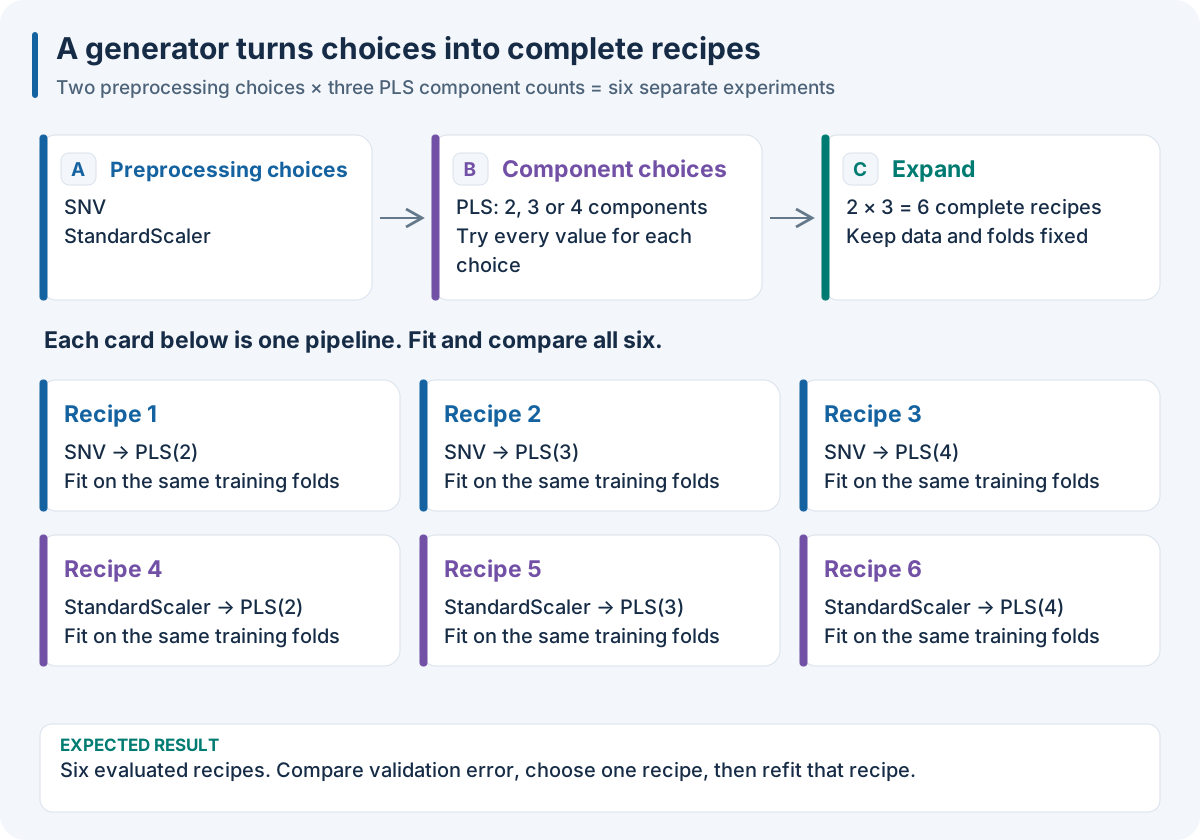
Two choices × three choices = six recipes. Each recipe gets the same data and folds, so only preprocessing and PLS complexity change.
Recipe |
Preprocessing |
PLS components |
What changes? |
|---|---|---|---|
1 |
SNV |
2 |
Normalize each spectrum; a small latent model |
2 |
SNV |
3 |
Same normalized spectra; one more component |
3 |
SNV |
4 |
Same normalized spectra; two more components |
4 |
StandardScaler |
2 |
Standardize each wavelength; a small latent model |
5 |
StandardScaler |
3 |
Same standardized data; one more component |
6 |
StandardScaler |
4 |
Same standardized data; two more components |
SNV removes each spectrum’s mean and rescales that spectrum’s variation. StandardScaler instead learns a mean and scale for each feature from training observations. PLS components summarize relationships between features and the measured target. More components increase flexibility and can increase overfitting.
Try the six-recipe experiment
The Python tab creates 48 synthetic observations with 31 features, including an
8-observation holdout. Save either configuration as pipeline.json or
pipeline.yaml; the Python tab is a complete standalone example. These data
illustrate software behavior, not instrument performance.
Note
These tabs express the same Python SDK workflow. JSON and YAML are recipe files; Python can also use sklearn/nirs4all objects. R, Octave and WASM native pipeline facades do not execute this host-controller node directly. For a recipe that runs in those languages, use 10. Run the same recipe in your language.
{
  "pipeline": [
    {
      "split": {
        "class": "sklearn.model_selection.KFold",
        "params": {
          "n_splits": 3,
          "shuffle": true,
          "random_state": 17
        }
      }
    },
    {
      "_or_": [
        {
          "class": "nirs4all.operators.transforms.StandardNormalVariate"
        },
        {
          "class": "sklearn.preprocessing.StandardScaler"
        }
      ]
    },
    {
      "model": {
        "class": "sklearn.cross_decomposition.PLSRegression",
        "params": {
          "n_components": {
            "_range_": [
              2,
              4
            ]
          }
        }
      }
    }
  ]
}
pipeline:
- split:
    class: sklearn.model_selection.KFold
    params:
      n_splits: 3
      shuffle: true
      random_state: 17
- _or_:
  - class: nirs4all.operators.transforms.StandardNormalVariate
  - class: sklearn.preprocessing.StandardScaler
- model:
    class: sklearn.cross_decomposition.PLSRegression
    params:
      n_components:
        _range_:
        - 2
        - 4
import tempfile
import numpy as np
import nirs4all
from nirs4all.data.dataset import SpectroDataset
from sklearn.model_selection import KFold
from sklearn.preprocessing import StandardScaler
from sklearn.cross_decomposition import PLSRegression
from nirs4all.operators.transforms import SNV
from nirs4all.pipeline.config import PipelineConfigs

rng = np.random.default_rng(17)
X = rng.normal(size=(48, 31))
y = 2 * X[:, 10] - X[:, 20] + rng.normal(scale=0.1, size=48)
dataset = SpectroDataset("worked_node")
dataset.add_samples(X[:40], {"partition": "train"},
                    headers=[str(i) for i in range(31)])
dataset.add_samples(X[40:], {"partition": "test"})
dataset.add_targets(y.reshape(-1, 1))


pipeline = [
    KFold(n_splits=3, shuffle=True, random_state=17),
    {"_or_": [SNV(), StandardScaler()]},
    {"model": {
        "class": PLSRegression,
        "params": {"n_components": {"_range_": [2, 4]}},
    }},
]
configs = PipelineConfigs(pipeline)
assert len(configs.steps) == 6
for number, steps in enumerate(configs.steps, 1):
    transform = steps[1]
    name = transform if isinstance(transform, str) else transform["class"]
    print(number, name.split(".")[-1],
          steps[2]["model"]["params"]["n_components"])
with tempfile.TemporaryDirectory() as workspace:
    result = nirs4all.run(pipeline, dataset, engine="legacy",
                         workspace_path=workspace, save_charts=False, verbose=0)
    print("Best validation score:", result.cv_best_score)
    print("Selected model test RMSE:", result.best_rmse)
    result.close()
What to expect: the preview prints the six rows listed above. Every recipe keeps 48 observation identities and 31 features. Three CV folds × six candidates require 18 fold model fits, before optional final refit. The best score depends on the data; the first candidate is not automatically the winner.
Choose the generator that matches your question
Your question |
Use |
Worked explanation |
|---|---|---|
Which one of these transforms? |
|
|
How many PLS components? |
|
|
Which strength over several orders of magnitude? |
|
|
Every combination of model parameters? |
|
|
Only matched parameter pairs? |
|
|
Every scatter/smoothing/derivative combination? |
|
|
A few randomly drawn values? |
|
|
A deliberate order of candidate recipes? |
|
|
Unordered sets of parallel views? |
|
|
Ordered sequences of transformations? |
|
|
A reproducible subset of a large search? |
|
|
Prevent inappropriate combinations? |
|
Alternatives, branches or extra views?
What you want |
Result |
Node |
|---|---|---|
Compare SNV against smoothing |
Two independent candidate recipes |
Generator |
Give one model SNV and smoothed features |
One wider matrix |
concat_transform: give one model several feature blocks or branch: let the same samples follow different paths + merge: decide what to bring back together |
Keep raw, SNV and derivative as named views |
Three representations of the same samples |
feature_augmentation: retain several views of the same observations |
Fit base models, then combine their predictions |
One stacking workflow |
branch: let the same samples follow different paths + prediction merge: decide what to bring back together |
A generator inside a duplication branch can create more simultaneous branches. At pipeline level it creates independently evaluated variants. Learn the top-level example before nesting searches into branches.
Common mistakes
Counting sums instead of products. Two transforms and three component counts produce six recipes. Four additional smoothing choices produce 24.
Treating
_range_like Python’srange. The upper bound is inclusive:[2, 4]means 2, 3 and 4.Using
arrangefor parallel views. Three operations taken two at a time give three unordered pairs withpick, six ordered pairs witharrange.Assuming
_zip_rejects unequal lengths. It stops at the shortest list. Keep lists equally long to avoid losing planned candidates.Calling
_chain_a transform chain. It enumerates candidates in order. Use a list inpreprocessingto apply SNV and then smoothing.Picking with the test set. Preserve an untouched final evaluation cohort.
Continue with Generator keywords: choices, combinations and their exact outputs for exact inputs and outputs. Runnable source: D01 generator syntax.