feature_augmentation: retain several views of the same observations
Raw spectra show absolute signal. SNV reduces within-spectrum offset and scale. A derivative emphasizes local changes. Retain all three instead of overwriting the last representation each time.
This node creates feature views. Every view describes the same observation; there is no new specimen and no new target measurement.
Worked example: raw, normalized and derivative views
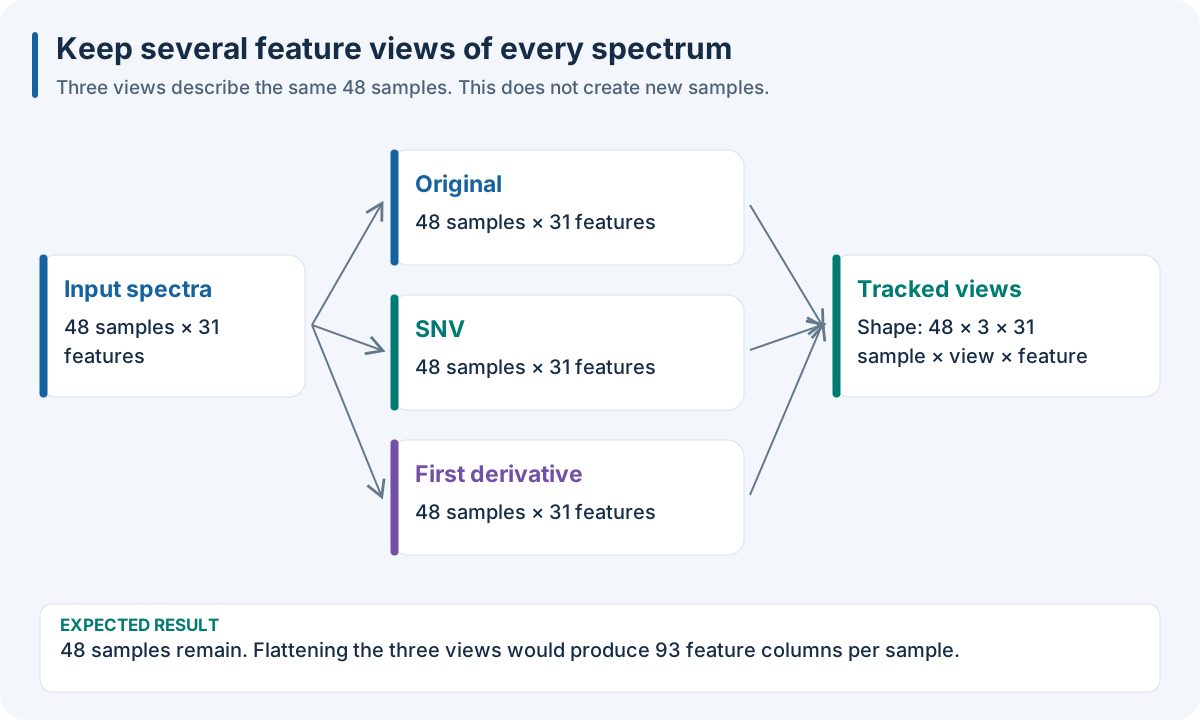
With action extend, raw plus two new views gives three views. A view-axis representation is 48 × 3 × 31.
Note
These tabs express the same Python SDK workflow. JSON and YAML are recipe files; Python can also use sklearn/nirs4all objects. R, Octave and WASM native pipeline facades do not execute this host-controller node directly. For a recipe that runs in those languages, use 10. Run the same recipe in your language.
{
  "pipeline": [
    {
      "split": {
        "class": "sklearn.model_selection.KFold",
        "params": {
          "n_splits": 3,
          "shuffle": true,
          "random_state": 17
        }
      }
    },
    {
      "feature_augmentation": [
        {
          "class": "nirs4all.operators.transforms.StandardNormalVariate"
        },
        {
          "class": "nirs4all.operators.transforms.SavitzkyGolay",
          "params": {
            "window_length": 7,
            "polyorder": 2,
            "deriv": 1
          }
        }
      ],
      "action": "extend"
    },
    {
      "model": {
        "class": "sklearn.cross_decomposition.PLSRegression",
        "params": {
          "n_components": 3
        }
      }
    }
  ]
}
pipeline:
- split:
    class: sklearn.model_selection.KFold
    params:
      n_splits: 3
      shuffle: true
      random_state: 17
- feature_augmentation:
  - class: nirs4all.operators.transforms.StandardNormalVariate
  - class: nirs4all.operators.transforms.SavitzkyGolay
    params:
      window_length: 7
      polyorder: 2
      deriv: 1
  action: extend
- model:
    class: sklearn.cross_decomposition.PLSRegression
    params:
      n_components: 3
import tempfile
import numpy as np
import nirs4all
from nirs4all.data.dataset import SpectroDataset
from sklearn.model_selection import KFold
from sklearn.cross_decomposition import PLSRegression
from nirs4all.operators.transforms import SNV, SavitzkyGolay

rng = np.random.default_rng(17)
X = rng.normal(size=(48, 31))
y = 2 * X[:, 10] - X[:, 20] + rng.normal(scale=0.1, size=48)
dataset = SpectroDataset("worked_node")
dataset.add_samples(X[:40], {"partition": "train"},
                    headers=[str(i) for i in range(31)])
dataset.add_samples(X[40:], {"partition": "test"})
dataset.add_targets(y.reshape(-1, 1))


pipeline = [
    KFold(n_splits=3, shuffle=True, random_state=17),
    {"feature_augmentation": [
        SNV(),
        SavitzkyGolay(window_length=7, polyorder=2, deriv=1),
    ], "action": "extend"},
    {"model": PLSRegression(n_components=3)},
]
with tempfile.TemporaryDirectory() as workspace:
    result = nirs4all.run(pipeline, dataset, engine="legacy",
                         workspace_path=workspace, save_charts=False, verbose=0)
    print("CV validation score:", result.cv_best_score)
    print("Selected model test RMSE:", result.best_rmse)
    result.close()
What to expect: raw, SNV and Savitzky–Golay first-derivative views remain.
There are 48 observation identities, 31 feature positions and three views.
The PLS matrix input flattens these equal-width views to 93 columns. A tensor
model can preserve the view axis with an appropriate supported layout.
The example selects the Python legacy controller and writes action explicitly.
The number of model recipes depends on the search topology, not simply the view count.
Enumerate action modes
Suppose two views already exist (raw and normalized), and you request two new transforms (smoothing and derivative).
|
Inputs transformed |
Old views retained? |
Resulting count |
|---|---|---|---|
|
Base/first view |
All |
2 old + 2 new = 4 |
|
Each of two old views |
All |
2 old + 4 new = 6 |
|
Each of two old views |
None |
4 new |
extend avoids duplicating an existing processing; the table assumes distinct
new views. Operations use the set of views present when the node begins. The
operations within a node do not themselves form a sequential chain.
Always write action: the historical implementation uses add when omitted,
despite older descriptions calling extend the default.
Compare combinations of views
pick: 2 chooses every pair of SNV, smoothing and derivative. extend also
keeps raw input in each candidate.
{
  "pipeline": [
    {
      "split": {
        "class": "sklearn.model_selection.KFold",
        "params": {
          "n_splits": 3,
          "shuffle": true,
          "random_state": 17
        }
      }
    },
    {
      "feature_augmentation": {
        "_or_": [
          {
            "class": "nirs4all.operators.transforms.StandardNormalVariate"
          },
          {
            "class": "nirs4all.operators.transforms.SavitzkyGolay",
            "params": {
              "window_length": 7,
              "polyorder": 2,
              "deriv": 0
            }
          },
          {
            "class": "nirs4all.operators.transforms.SavitzkyGolay",
            "params": {
              "window_length": 7,
              "polyorder": 2,
              "deriv": 1
            }
          }
        ],
        "pick": 2
      },
      "action": "extend"
    },
    {
      "model": {
        "class": "sklearn.cross_decomposition.PLSRegression",
        "params": {
          "n_components": 3
        }
      }
    }
  ]
}
pipeline:
- split:
    class: sklearn.model_selection.KFold
    params:
      n_splits: 3
      shuffle: true
      random_state: 17
- feature_augmentation:
    _or_:
    - class: nirs4all.operators.transforms.StandardNormalVariate
    - class: nirs4all.operators.transforms.SavitzkyGolay
      params:
        window_length: 7
        polyorder: 2
        deriv: 0
    - class: nirs4all.operators.transforms.SavitzkyGolay
      params:
        window_length: 7
        polyorder: 2
        deriv: 1
    pick: 2
  action: extend
- model:
    class: sklearn.cross_decomposition.PLSRegression
    params:
      n_components: 3
from nirs4all.operators.transforms import SavitzkyGolay
from nirs4all.operators.transforms import StandardNormalVariate as SNV
from sklearn.cross_decomposition import PLSRegression
from sklearn.model_selection import KFold

pipeline = [{'split': KFold(n_splits=3, shuffle=True, random_state=17)},
 {'feature_augmentation': {'_or_': [SNV(),
                                    SavitzkyGolay(window_length=7, polyorder=2, deriv=0),
                                    SavitzkyGolay(window_length=7, polyorder=2, deriv=1)],
                           'pick': 2},
  'action': 'extend'},
 {'model': PLSRegression(n_components=3)}]
Expected result: three candidate recipes: raw + SNV + smoothing; raw + SNV + derivative; raw + smoothing + derivative. Each has three 31-column views. The first example is one experiment with three views; this is three experiments.
View, column or observation?
Node |
Adds |
More observation rows? |
|---|---|---|
|
Named representations |
No |
Columns in one matrix |
No |
|
sample_augmentation: give training examples plausible variants |
Synthetic training observations |
Yes, during training |
Alternative recipes |
No, within each recipe |
Common mistakes
Extra views do not create independent biological replication.
Repeated
addgrows quickly: two views and three transforms yield eight views.PCA and other reductions produce unequal widths. Prefer
concat_transformfor unequal-width blocks consumed as a matrix.A 3D layout does not teach a matrix-only estimator to accept tensors.
Runnable U02 tutorial. See Operator steps: describe an algorithm and its settings for layouts and Public execution matrix for supported shapes.